November 29, 2013, Flagstaff, Arizona. Well, Black Friday is almost over and I'm happy to say that the score is Joe Lizura (www.joelizura.com) one and the stores zero. After a long drive from Flagstaff down to Scottsdale to spend a few hours in the shopping mayhem, it actually turned out be fun. I didn't actually buy anything, but everyone else in the family did. I did however, get a kick out of the fact that stores were doing their best to out-do one another. One store was 40 percent off everything, followed by the next which was 50 percent off and that was yet followed by the next one that was 60 percent off!
It's definitely going to be a great holiday shopping season, but it's going to be a quick one, after all,
Christmas is just three and a half weeks away! You know what that means . . . Cyber-Monday is going to be crazy! And tomorrow isn't looking to bad either; I just saw a commercial for 10 dollars off your 25 dollar purchase at Macys!
Shop well my friends, shop well! www.joelizura.net
Friday, November 29, 2013

Thursday, November 28, 2013
Joe Lizura's turkey cooking chart
Happy Thanksgiving 2013! It's one of my favorite days of the year (although not my actual favorite, which is Halloween) because Thanksgiving brings the family together for the official start of the entire holiday season. Lot's of football to watch on TV and in some cases snow to shovel!
I'm not sure about everyone else, but it seems that our family (even when I was a kid) could never get an accurate explanation of how many hours to cook the Turkey - No matter who you ask, it's always about things like "Is it a stuffed turkey or unstuffed turkey?", "Are you cooking it at 325 degrees or 350 degrees?", "Is it a fresh turkey or a frozen one?", and on an on ... but this year, I think I found the perfect chart for cooking - here it is!
For an unstuffed turkey, place the meat thermometer in the thickest part of the thigh, taking care that it does not touch any bone. Roast the turkey until the meat thermometer reaches 165 degrees F. Don't forget to let the bird rest at least 30 minutes before carving to allow the juices to re-absorb into the flesh. You don't want the moisture to drain out.
Roasting times are for a preheated 325 degrees F. oven.
I'm not sure about everyone else, but it seems that our family (even when I was a kid) could never get an accurate explanation of how many hours to cook the Turkey - No matter who you ask, it's always about things like "Is it a stuffed turkey or unstuffed turkey?", "Are you cooking it at 325 degrees or 350 degrees?", "Is it a fresh turkey or a frozen one?", and on an on ... but this year, I think I found the perfect chart for cooking - here it is!
For an unstuffed turkey, place the meat thermometer in the thickest part of the thigh, taking care that it does not touch any bone. Roast the turkey until the meat thermometer reaches 165 degrees F. Don't forget to let the bird rest at least 30 minutes before carving to allow the juices to re-absorb into the flesh. You don't want the moisture to drain out.
Roasting times are for a preheated 325 degrees F. oven.
| Approximate Roasting Times for Stuffed Turkey | |
| 6 to 8 pounds | 3 to 3-1/2 hours |
| 8 to 12 pounds | 3-1/2 to 4-1/2 hours |
| 12 to 16 pounds | 4-1/2 to 5-1/2 hours |
| 16 to 20 pounds | 5-1/2 to 6 hours |
| 20 to 24 pounds | 6 to 6-1/2 hours |
| Approximate Roasting Times for Unstuffed Turkey | |
| 6 to 8 pounds | 2-1/2 to 3 hours |
| 8 to 12 pounds | 3 to 4 hours |
| 12 to 16 pounds | 4 to 5 hours |
| 16 to 20 pounds | 5 to 5-1/2 hours |
| 20 to 24 pounds | 5-1/2 to 6 hours |
Wednesday, November 20, 2013
Sad news from the Disney Family
I was sad to learn today that Walt Disney's daughter Diane Disney Miller passed away today at age 79. Its wonderful to know that a family you have never met has made such a dramatic impact on your life. Walt Disney was widely credited with creating Disneyland in a large part as something to
give his daughter and we are all better off because he did.
 Diane was a very generous woman who gave away millions and millions of dollars to charities and
deserving organizations - exactly as her father would have wanted her too. Rest in Peace and tell your father "thank you".
give his daughter and we are all better off because he did.

deserving organizations - exactly as her father would have wanted her too. Rest in Peace and tell your father "thank you".
Thursday, October 3, 2013
Absolutely Awesome - Check it out!
October 3, 2013. Joe Lizura Blog update. A very good friend of mine shared this on linkedin today and I wanted to pass it on . . although it's an ad from Intel, the story is really, really cool. Here is the link: http://www.adweek.com/adfreak/most-uplifting-ad-youll-see-today-about-15-year-olds-incredible-cancer-research-152827
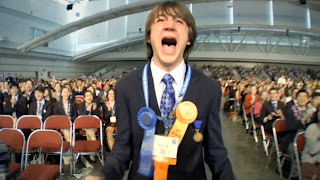 It's being called the most uplifting ad you'll see - they also should have called it the most inspirational ad as well. Here is a little bit of the back-story:
Jack Andraka, barely a teenager, decided to develop an early-detection test for pancreatic cancer after his uncle died from the disease. He asked 200 researchers and other experts for help. Only one, a doctor of oncology at Johns Hopkins, provided him with lab space to use after school. At age 15, Andraka succeeded in developing a test that is 168 times faster, 400 times more sensitive, and 26,000 times less expensive than the medical standard.
Joe Lizura
www.Joelizura.com

Jack Andraka, barely a teenager, decided to develop an early-detection test for pancreatic cancer after his uncle died from the disease. He asked 200 researchers and other experts for help. Only one, a doctor of oncology at Johns Hopkins, provided him with lab space to use after school. At age 15, Andraka succeeded in developing a test that is 168 times faster, 400 times more sensitive, and 26,000 times less expensive than the medical standard.
Intel tells Andraka's story in the ad below. What does a computer-chip manufacturer have to do with his invention? Not much, but Intel is the headlining sponsor—and has been since 1997—of the International Science and Engineering Fair, which gave Andraka its $75,000 grand prize for his work.
The spot, from Venables Bell & Partners (and director Britton Caillouette of Farm League, himself a bone-cancer survivor), is a little self-congratulatory on Intel's part. But it's clever, too. The ad, which proceeds in reverse chronology, might make you feel the same sort of skepticism about Andraka that his idea met—but then you'll feel like a fool when you realize how quite amazing his accomplishment is.
Joe Lizura
www.Joelizura.com
Wednesday, October 2, 2013
The passing of Tom Clancy

Here is a little bit about him and his work from the Associated Press.
NEW YORK (AP) — Tom Clancy, whose high-tech, Cold War thrillers such as "The Hunt for Red October" and "Patriot Games" made him the most widely read and influential military novelist of his time, has died. He was 66.
Penguin Group (USA) announced that Clancy had died Tuesday in Baltimore. The publisher did not provide a cause of death.
Tall and thin, with round, sunken eyes that were often hidden by sunglasses, Clancy had said his dream had been simply to publish a book, hopefully a good one, so that he would be in the Library of Congress catalog. His dreams were answered many times over.
His novels were dependable best sellers, with his publisher estimating that worldwide sales top 100 million copies. Several, including "The Hunt for Red October," ''Patriot Games" and "Clear and Present Danger," were later made into blockbuster movies, with another based on his desk-jockey CIA hero, "Jack Ryan," set for release on Christmas. Alec Baldwin, Ben Affleck and Harrison Ford were among the actors who played Ryan on screen. The upcoming movie stars Chris Pine, Keira Knightly and Kevin Costner, with Kenneth Branagh directing.
In real life, the ship didn't defect, but in Clancy's book, published in 1984, the defection was a success. Someone thought enough of the book to give it to President Reagan as a Christmas gift. The president quipped at a dinner that he was losing sleep because he couldn't put the book down — a statement Clancy later said helped put him on the New York Times best-seller list.
Clancy was admired in the military community, and appeared — though he often denied it — to have the kind of access that enabled him to intricately describe anything from surveillance to the operations of a submarine. He often played off — and sometimes anticipated — world events, as in the pre-9/11 paranoid thriller "Debt of Honor," in which a jumbo jet destroys the U.S. Capitol during a joint meeting of Congress.
Earning million-dollar advances for his novels, he also wrote nonfiction works on the military and even ventured into video games, including the best-selling "Tom Clancy's Ghost Recon: Future Soldier," ''Tom Clancy's Splinter Cell: Conviction" and "Tom Clancy's Splinter Cell: Double Agent." His recent Jack Ryan novels were collaborations with Mark Greaney, including "Threat Vector" and a release scheduled for December, "Command Authority."
As of midday Wednesday, "Command Authority" ranked No. 40 on Amazon.com's best seller list.
Born in Baltimore on April 12, 1947 to a mailman and his wife, Clancy entered Loyola College as a physics major, but switched to English as a sophomore. He later said that he wasn't smart enough for the rigors of science, although he clearly mastered it well enough in his fiction.
Clancy stayed close to home. He resided in rural Calvert County, Md., and in 1993 he joined a group of investors led by Baltimore attorney Peter Angelos who bought the Baltimore Orioles from businessman Eli Jacobs. Clancy also attempted to bring a NFL team to Baltimore in 1993, but he later dropped out.
Tom Clancy will definitely be missed. RIP.
Joe Lizura
www.joelizura.com
www.twitter.com/joelizura
Tuesday, October 1, 2013
The Strange Reality of Climate Change
Joe Lizura's Blog on October 1, 2013. I saw a story today, and you'll see the link to it below, and it struck me a little more than most climate change stories I run across on a weekly basis. For those
who may know, as an actual Meteorologist, I tend to look at global climate change with a little more of a scientific viewpoint and a little less of an emotional viewpoint. So to that end, let me just say that global climate change is definitely going on -- but then again it always has been. Take for example the very ground I walk on every day in San Diego it's covered with Rocks -- round smooth rocks and when you get into the inland valleys, those smooth round rocks (about the size of a softballs) grow larger and larger until they are the size of small bolders and then larger and larger until they are big bolders. the odd part about the boulders and the rocks is that they are smooth, very much like the kind that you would find at the bottom of a river. So the question begs: How did about a million round river rocks wind up in San Diego? Is it from the ocean from way back when this part of the continent was under water? Nope -- true, it's where the sand came from and the shells that you can dig up in the inland valleys, but that's not where the rocks and boulders came from. So where then? The answer is a little surprising, it's from the end of the last Ice Age as this very southwestern part of the land mass is the farthest extreme expansion of the ice. The rocks and boulders left everywhere are actually rocks and boulders that the ice sheets pushed for a thousand miles, making them smoother and smoother as they slowly got pushed and tumbled and pushed again by the moving ice sheets, until nature smoothed them out like they were forever in a river (which I guess a river of ice would qualify).
So what's the point? Just that climate change is ALWAYS going on, and in the scheme of hundreds of millions of years, our mankind is just a blip of a factor in creating or perhaps enhancing a climate change that has most likely been going on for ten thousand years.
That's why you'll never hear me argue that there isn't global climate change, because there is - there always has been - places like the Sahara Desert were once lush landscapes of vegetation and life but are now endless miles of nearly lifeless sand - not because ancient man did anything, but because it was a much longer scale climate change that mankind just happens to have found itself in the middle of.
That doesn't mean that we aren't making it worse, or making it happen faster, because we are, we definitely are exasperating the problem and rather than waiting ten thousand years to feel the effects, we are likely to feel the effects in 50 years - that's pretty amazing. So is this story below about what is happening in Alaska - check this out.
ANCHORAGE, Alaska (AP) — An estimated 10,000 walrus unable to find sea ice over shallow Arctic Ocean water have come ashore on Alaska's northwest coast.
Scientists with the National Oceanic and Atmospheric Administration on Friday photographed walrus packed onto a beach on a barrier island near Point Lay, an Inupiat Eskimo village 300 miles southwest of Barrow and 700 miles northwest of Anchorage.
 The walrus have been coming to shore since mid-September. The large herd was spotted during NOAA's annual arctic marine mammal aerial survey, an effort conducted with the Bureau of Ocean Energy Management, the agency that conducts offshore lease sales.
An estimated 2,000 to 4,000 walrus were photographed at the site Sept. 12. The U.S. Fish and Wildlife Service, the agency that manages walrus, immediately took steps to prevent a stampede among the animals packed shoulder to shoulder on the rocky coastline. The agency works with villages to keep people and airplanes a safe distance from herds.
Young animals are especially vulnerable to stampedes triggered by a polar bear, a human hunter or a low-flying airplane. The carcasses of more than 130 mostly young walruses were counted after a stampede in September 2009 at Alaska's Icy Cape.
The gathering of walrus on shore is a phenomenon that has accompanied the loss of summer sea ice as the climate has warmed.
Pacific walrus spend winters in the Bering Sea. Females give birth on sea ice and use ice as a diving platform to reach snails, clams and worms on the shallow continental shelf.
As temperatures warm in summer, the edge of the sea ice recedes north. Females and their young ride the edge of the sea ice into the Chukchi Sea. However, in recent years, sea ice has receded north beyond continental shelf waters and into Arctic Ocean water 10,000 feet deep or more where walrus cannot dive to the bottom.
Walrus in large numbers were first spotted on the U.S. side of the Chukchi Sea in 2007. They returned in 2009, and in 2011, scientists estimated 30,000 walruses along one kilometer of beach near Point Lay.
Remnant ice kept walrus offshore in 2008 and again last year.
The goal of the marine mammals survey is to record the abundance of bowhead, gray, minke, fin and beluga whales plus other marine mammals in areas of potential oil and natural gas development, said NOAA Fisheries marine mammal scientist Megan Ferguson in an announcement.
"In addition to photographing the walrus haulout area, NOAA scientists documented more bowhead whales, including calves and feeding adults in the Beaufort Sea this summer compared to 2012," said Ferguson. "We are also seeing more gray whale calves in the Chukchi Sea than we have in recent years."
Environmental groups say the loss of sea ice due to climate warming is harming marine mammals and oil and gas development would add to their stress.
Well, as I said, global climate change goes on, with or without us, but with us it is going on at a rate that is unprecedented. There's no doubt that we are going to see the changes in our lifetime - we already are, but I just don't think that we are going to like what we see.
Thanks for reading my blog! Joe Lizura
Catch Joe Lizura on Linked in by clicking here: www.linkedin.com/in/joelizura
Joe Lizura is also on twitter at: www.twitter.com/joelizura
 |
| Joe Lizura in San Diego |
So what's the point? Just that climate change is ALWAYS going on, and in the scheme of hundreds of millions of years, our mankind is just a blip of a factor in creating or perhaps enhancing a climate change that has most likely been going on for ten thousand years.
That's why you'll never hear me argue that there isn't global climate change, because there is - there always has been - places like the Sahara Desert were once lush landscapes of vegetation and life but are now endless miles of nearly lifeless sand - not because ancient man did anything, but because it was a much longer scale climate change that mankind just happens to have found itself in the middle of.
That doesn't mean that we aren't making it worse, or making it happen faster, because we are, we definitely are exasperating the problem and rather than waiting ten thousand years to feel the effects, we are likely to feel the effects in 50 years - that's pretty amazing. So is this story below about what is happening in Alaska - check this out.
ANCHORAGE, Alaska (AP) — An estimated 10,000 walrus unable to find sea ice over shallow Arctic Ocean water have come ashore on Alaska's northwest coast.
Scientists with the National Oceanic and Atmospheric Administration on Friday photographed walrus packed onto a beach on a barrier island near Point Lay, an Inupiat Eskimo village 300 miles southwest of Barrow and 700 miles northwest of Anchorage.

An estimated 2,000 to 4,000 walrus were photographed at the site Sept. 12. The U.S. Fish and Wildlife Service, the agency that manages walrus, immediately took steps to prevent a stampede among the animals packed shoulder to shoulder on the rocky coastline. The agency works with villages to keep people and airplanes a safe distance from herds.
Young animals are especially vulnerable to stampedes triggered by a polar bear, a human hunter or a low-flying airplane. The carcasses of more than 130 mostly young walruses were counted after a stampede in September 2009 at Alaska's Icy Cape.
The gathering of walrus on shore is a phenomenon that has accompanied the loss of summer sea ice as the climate has warmed.
Pacific walrus spend winters in the Bering Sea. Females give birth on sea ice and use ice as a diving platform to reach snails, clams and worms on the shallow continental shelf.
As temperatures warm in summer, the edge of the sea ice recedes north. Females and their young ride the edge of the sea ice into the Chukchi Sea. However, in recent years, sea ice has receded north beyond continental shelf waters and into Arctic Ocean water 10,000 feet deep or more where walrus cannot dive to the bottom.
Walrus in large numbers were first spotted on the U.S. side of the Chukchi Sea in 2007. They returned in 2009, and in 2011, scientists estimated 30,000 walruses along one kilometer of beach near Point Lay.
Remnant ice kept walrus offshore in 2008 and again last year.
The goal of the marine mammals survey is to record the abundance of bowhead, gray, minke, fin and beluga whales plus other marine mammals in areas of potential oil and natural gas development, said NOAA Fisheries marine mammal scientist Megan Ferguson in an announcement.
"In addition to photographing the walrus haulout area, NOAA scientists documented more bowhead whales, including calves and feeding adults in the Beaufort Sea this summer compared to 2012," said Ferguson. "We are also seeing more gray whale calves in the Chukchi Sea than we have in recent years."
Environmental groups say the loss of sea ice due to climate warming is harming marine mammals and oil and gas development would add to their stress.
Well, as I said, global climate change goes on, with or without us, but with us it is going on at a rate that is unprecedented. There's no doubt that we are going to see the changes in our lifetime - we already are, but I just don't think that we are going to like what we see.
Thanks for reading my blog! Joe Lizura
Catch Joe Lizura on Linked in by clicking here: www.linkedin.com/in/joelizura
Joe Lizura is also on twitter at: www.twitter.com/joelizura
Thursday, April 18, 2013
Fire Up The Volcano - Yellowstone Is Even Bigger Than We Knew
April 18, 2013; Looks like we have something even bigger to worry about than we thought! According to a new research report out this week, the volcano that fuels Yellowstone park and all its wonders is even bigger than scientists first thought.
"We are getting a much better understanding of the volcanic system of Yellowstone," said Jamie Farrell, a seismology graduate student at the University of Utah. "The magma reservoir is at least 50 percent larger than previously imaged."
Knowing the volume of molten magma beneath Yellowstone is important for estimating the size of future eruptions, Farrell told OurAmazingPlanet.
The magma chamber seen in the new study fed these smaller eruptions and is the source of the park's amazing hydrothermal springs and geysers. It also creates the surface uplift seen in the park, said Bob Smith, a seismologist at the University of Utah and author of a related study presented at the meeting.
"This crustal magma body is a little dimple that creates the uplift," Smith said. "It's like putting your finger under a rubber membrane and pushing it up and the sides expand."
A clearer picture of Yellowstone's shallow magma chamber emerged from earthquakes, whose waves change speed when they travel through molten or solid rock. Farrell analyzed nearby earthquakes to build a picture of the magma chamber.
The underground magma resembles a mutant banana, with a knobby, bulbous end poking up toward the northeast corner of Yellowstone National Park, and the rest of the tubular fruit angling shallowly southwest. It's a single connected chamber, about 37 miles (60 kilometers) long, 18 miles (30 km) wide, and 3 to 7 miles (5 to 12 km) deep.
Previously, researchers had thought the magma beneath Yellowstone was in separate blobs, not a continuous pocket. The shallowest magma, in the northeast, also matches up with the park's most intense hydrothermal activity, Farrell said. The new study is the best view yet of this zone, which lies outside the youngest caldera rim.
Additional molten rock, not imaged in this study, also exists deeper beneath Yellowstone, scientists think.
The planet is indeed such a marvelous thing, and hundreds of thousands of years from now, just through natural causes, the continent we know as North America will likely bear very little resemblance to what it looks like now. In fact, if the volcano below Yellowstone ever erupts with all of it's potential, there's a good chance that a big part of the world will undergo a huge change.
blog post by Joe lizura
visit joe lizura on his website at www.joelizura.net
or visit lizura on LinkedIn at www.linkedin.com/in/joelizura
"We are getting a much better understanding of the volcanic system of Yellowstone," said Jamie Farrell, a seismology graduate student at the University of Utah. "The magma reservoir is at least 50 percent larger than previously imaged."
Knowing the volume of molten magma beneath Yellowstone is important for estimating the size of future eruptions, Farrell told OurAmazingPlanet.
Geologists believe Yellowstone sits over a hotspot, a plume of superheated rock rising from Earth's mantle. As North America slowly drifted over the hotspot, the Yellowstone plume punched through the continent's crust, leaving a bread-crumb-like trail of calderas created by massive volcanic eruptions along Idaho's Snake River Plain, leading straight to Yellowstone. The last caldera eruption was 640,000 years ago. Smaller eruptions occurred in between and after the big blasts, most recently about 70,000 years ago. [Infographic: Geology of Yellowstone]
The magma chamber seen in the new study fed these smaller eruptions and is the source of the park's amazing hydrothermal springs and geysers. It also creates the surface uplift seen in the park, said Bob Smith, a seismologist at the University of Utah and author of a related study presented at the meeting.
The volcanic plume of partly molten rock that feeds the Yellowstone supervolcano. Yellow and red indicate higher conductivity, green and blue indicate lower conductivity. Made by University of Utah geophysicists and computer scientists, this is the first large-scale 'geoelectric' image of the Yellowstone hotspot.
"This crustal magma body is a little dimple that creates the uplift," Smith said. "It's like putting your finger under a rubber membrane and pushing it up and the sides expand."
A clearer picture of Yellowstone's shallow magma chamber emerged from earthquakes, whose waves change speed when they travel through molten or solid rock. Farrell analyzed nearby earthquakes to build a picture of the magma chamber.
The underground magma resembles a mutant banana, with a knobby, bulbous end poking up toward the northeast corner of Yellowstone National Park, and the rest of the tubular fruit angling shallowly southwest. It's a single connected chamber, about 37 miles (60 kilometers) long, 18 miles (30 km) wide, and 3 to 7 miles (5 to 12 km) deep.
Previously, researchers had thought the magma beneath Yellowstone was in separate blobs, not a continuous pocket. The shallowest magma, in the northeast, also matches up with the park's most intense hydrothermal activity, Farrell said. The new study is the best view yet of this zone, which lies outside the youngest caldera rim.
Additional molten rock, not imaged in this study, also exists deeper beneath Yellowstone, scientists think.
The planet is indeed such a marvelous thing, and hundreds of thousands of years from now, just through natural causes, the continent we know as North America will likely bear very little resemblance to what it looks like now. In fact, if the volcano below Yellowstone ever erupts with all of it's potential, there's a good chance that a big part of the world will undergo a huge change.
blog post by Joe lizura
visit joe lizura on his website at www.joelizura.net
or visit lizura on LinkedIn at www.linkedin.com/in/joelizura
Subscribe to:
Posts (Atom)